Most privileges are invisible to the people who have them.
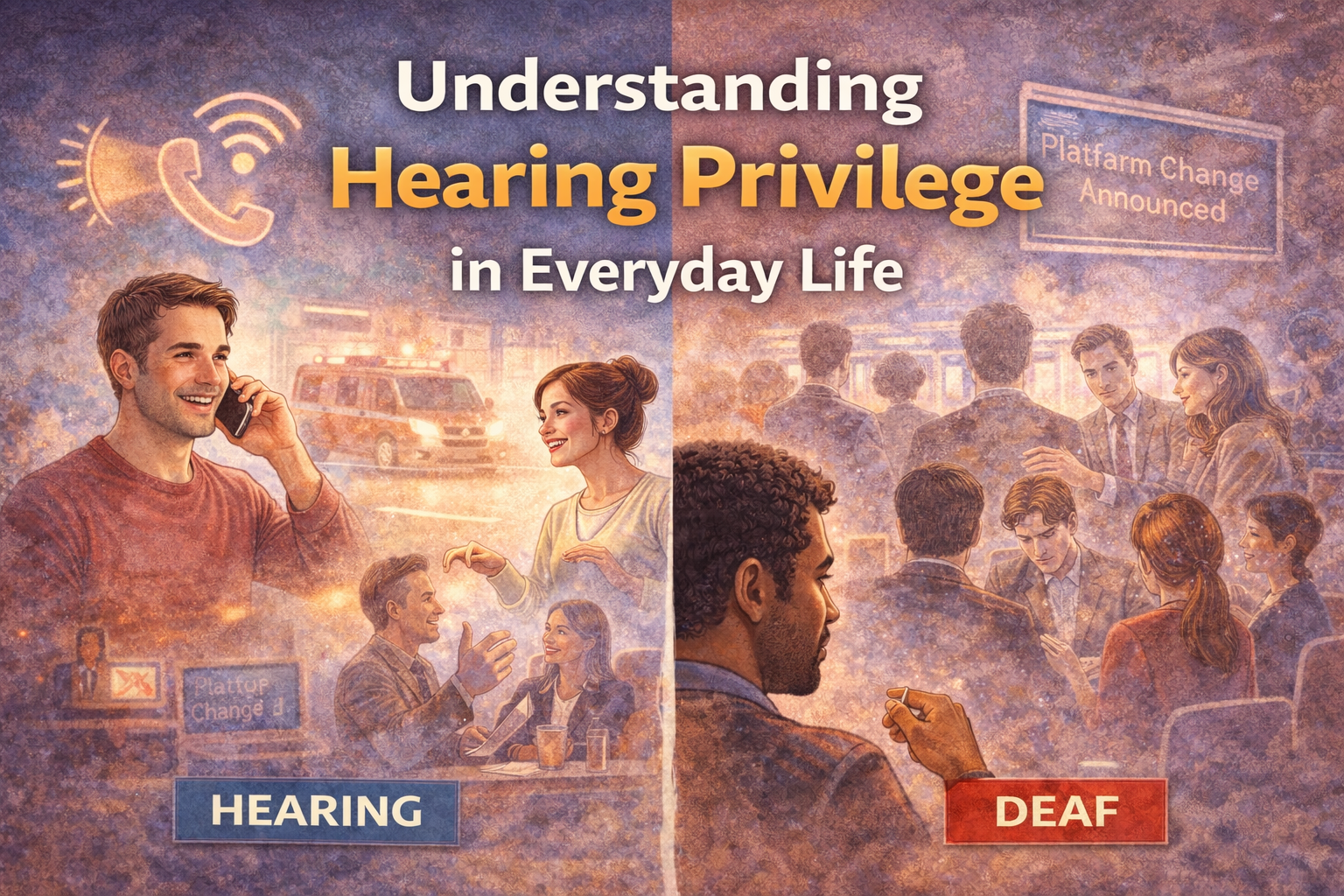
If you have never struggled to hear an announcement in a train station…
If you have never worried about missing your name being called in a hospital waiting room…
If you have never been excluded from a conversation because it moved too fast…
Then you are experiencing something called hearing privilege.
Hearing privilege is not about guilt.
It is not about blame.
It is not about comparing struggles.
It is about awareness.
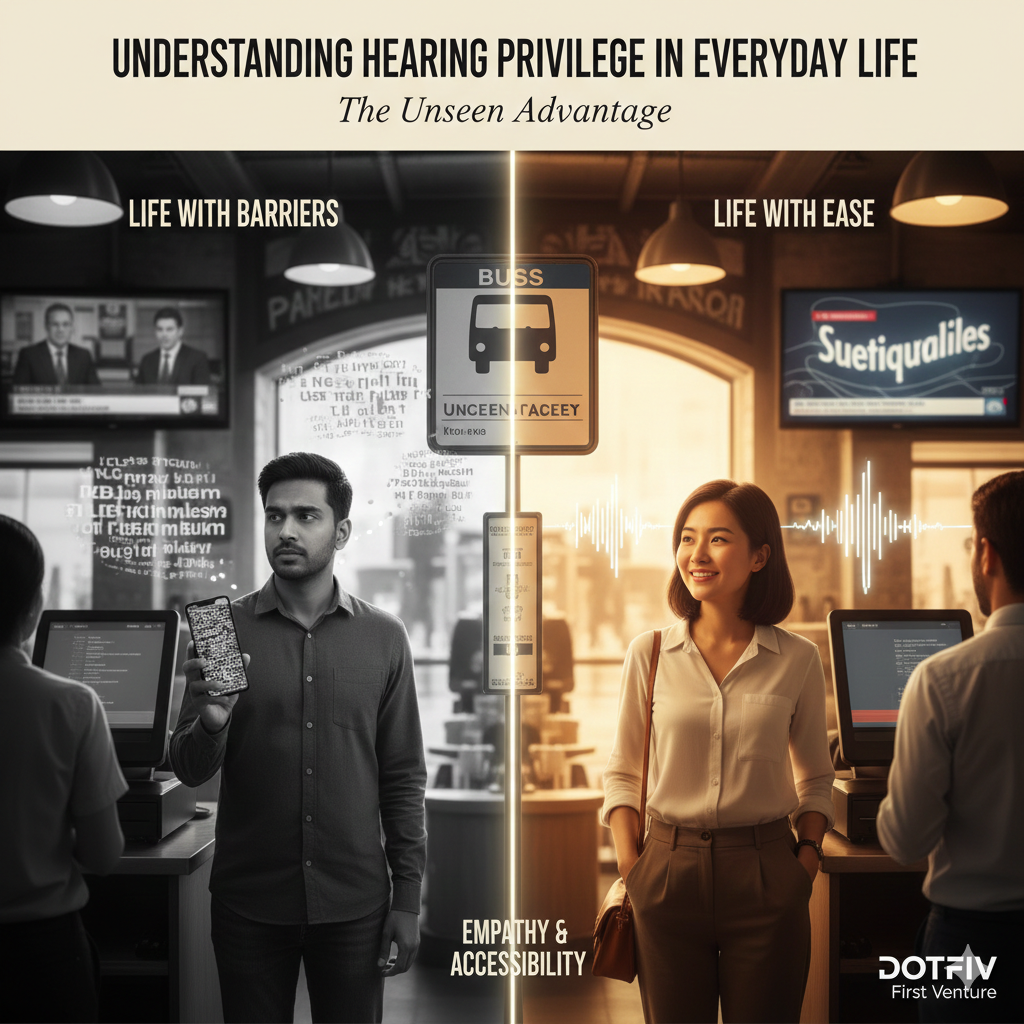
It is the unearned advantage that hearing people experience simply because society is built around sound.
And once you begin to see it, you realize it is everywhere.
What Is Hearing Privilege?
Hearing privilege refers to the social advantages that hearing individuals experience in a world designed primarily for auditory communication.
It shows up in:
– Education systems
– Workplace environments
– Public transportation
– Healthcare settings
– Social gatherings
– Emergency systems
– Media and entertainment
Hearing people move through daily life without needing accommodations for communication. Deaf individuals often must adapt, request access, advocate, and adjust constantly.
The privilege lies in not having to think about access.
Why Many People Don’t Notice It
Privilege is often invisible to those who benefit from it.
If sound works for you, the world feels normal.
Doorbells.
Sirens.
Phone calls.
Group conversations.
Background music.
Public announcements.
You rarely question their accessibility.
But for Deaf individuals, these systems can create daily barriers.
When something is designed around sound, those who do not rely on sound must work harder to participate.
That extra effort is where privilege becomes clear.
Everyday Examples of Hearing Privilege
Let’s make this practical.
Here are common situations where hearing privilege appears:
Public Announcements
Airports, train stations, and bus terminals frequently rely on audio announcements. If a platform changes suddenly, hearing individuals adjust immediately. Deaf individuals may miss critical information without clear visual displays.
Emergency Alerts
Fire alarms, police sirens, and evacuation instructions are often sound-based. Without visual alerts or vibrating systems, safety becomes unequal.
Phone-Based Services
Banking, customer support, medical appointments, and government services frequently depend on phone communication. Hearing individuals simply call. Deaf individuals must arrange relay services or seek alternatives.
Social Gatherings
Group conversations move quickly. People interrupt each other. Multiple voices overlap. For Deaf individuals, following these discussions requires extra concentration or interpretation support.
Job Interviews
Most interviews prioritize spoken communication. Without interpreters or inclusive practices, Deaf candidates may be unfairly evaluated.
Education
Teachers may lecture without captions or visual reinforcement. Hearing students absorb information naturally. Deaf students depend on interpreters or note-taking systems.
None of these situations are malicious. But they reveal systemic design centered around hearing.
The Emotional Impact of Constant Adaptation
Imagine navigating every day knowing you must ask for accommodations repeatedly.
“Can you repeat that?”
“Could you face me while speaking?”
“Is there an interpreter available?”
“Can you provide captions?”
This constant advocacy is exhausting.
Hearing privilege means not having to ask.
For Deaf individuals, communication access is not automatic. It requires planning, coordination, and sometimes negotiation.
This creates:
– Communication fatigue
– Social anxiety
– Frustration
– Feeling overlooked
– Emotional isolation
The exhaustion is not from Deafness itself. It comes from navigating a hearing-centered world.
Hearing Privilege in the Workplace
In professional settings, hearing privilege often determines opportunity.
Informal networking — hallway chats, spontaneous phone calls, after-work gatherings — plays a major role in career advancement.
Hearing employees participate naturally.
Deaf employees may miss unplanned conversations that influence promotions, collaborations, or leadership opportunities.
Meetings without captions or interpreters create unequal access to information.
Even simple office tools like intercom announcements can exclude.
The privilege is not needing accommodation to succeed.
Hearing Privilege in Education
Classrooms are often sound-driven environments.
Teachers lecture.
Students discuss verbally.
Instructions are spoken quickly.
Without captioning, interpreters, or visual learning strategies, Deaf students face systemic disadvantage.
Hearing students absorb learning passively. Deaf students must rely on structured access systems.
Education equality requires language accessibility from early childhood onward.
The Role of Media and Entertainment
Television shows, podcasts, news broadcasts, and social media content are largely audio-based.
Captions have improved significantly over time, but not all content includes accurate or synchronized subtitles.
Podcasts rarely provide transcripts.
Live events often lack real-time captioning.
Hearing privilege means consuming content effortlessly.
Accessibility transforms participation.
Understanding Hearing Privilege Is Not About Blame
Some people react defensively to the word “privilege.”
But recognizing hearing privilege does not mean hearing individuals are at fault for being born hearing.
It simply means acknowledging that systems favor certain abilities.
Awareness is the first step toward fairness.
When privilege is invisible, inequality continues unnoticed.
When privilege is recognized, change becomes possible.
The Intersection of Hearing Privilege and Mental Health
Communication barriers affect emotional wellbeing.
When Deaf individuals experience repeated exclusion, misunderstandings, or dismissal, it can impact:
– Self-esteem
– Confidence
– Social belonging
– Stress levels
Mental health services are also often designed for hearing individuals.
Limited availability of sign-fluent therapists adds another barrier.
Hearing privilege includes access to communication-based emotional support systems.
Small Changes That Reduce Hearing Privilege Gaps
Inclusion does not require dramatic transformation overnight.
Small adjustments make significant impact:
– Always include captions in videos
– Face people when speaking
– Avoid covering your mouth
– Use visual alarms in public buildings
– Provide written summaries of meetings
– Offer interpreter services proactively
– Encourage basic sign language education
These steps normalize accessibility instead of treating it as special treatment.
Technology and Accessibility Innovation
Technology offers opportunity to reduce hearing privilege gaps.
Real-time captioning tools
Video relay services
Speech-to-text applications
Visual alert systems
AI-powered accessibility tools
However, technology must be designed with Deaf communities involved in development.
Inclusion cannot happen without representation.
The Power of Allyship
If you are hearing, you can contribute to change.
Advocate for captions in your workplace.
Encourage sign language learning in schools.
Challenge outdated language.
Support Deaf-led organizations.
Listen to Deaf voices directly.
Allyship is not about speaking for the community. It is about amplifying and supporting.
Shifting From Sound-Centered to Inclusive Design
Imagine a world where communication defaults to multiple formats:
Sound + text
Speech + sign
Announcements + visual alerts
Phone + chat options
This design benefits not only Deaf individuals but also:
– Non-native language speakers
– People in noisy environments
– Individuals with temporary hearing challenges
– Older adults
Accessibility improves life for everyone.
Why Awareness Matters
Ignoring hearing privilege maintains inequality.
Understanding hearing privilege creates:
– Empathy
– Better policies
– Inclusive education systems
– Accessible workplaces
– Stronger communities
Awareness transforms perspective.
Instead of asking, “Why don’t Deaf people adapt?”
We begin asking, “How can we design systems that include everyone?”
A Final Reflection
Hearing privilege is quiet.
It operates in the background of daily life.
It exists in every phone call you make easily.
In every announcement you hear automatically.
In every group conversation you follow without effort.
Recognizing it does not diminish your experience.
It expands your awareness.
When we acknowledge hearing privilege, we move closer to equality.
When we design communication systems beyond sound alone, we build a world that reflects human diversity.
Inclusion is not charity.
Accessibility is not special treatment.
It is fairness.
And fairness begins with understanding.