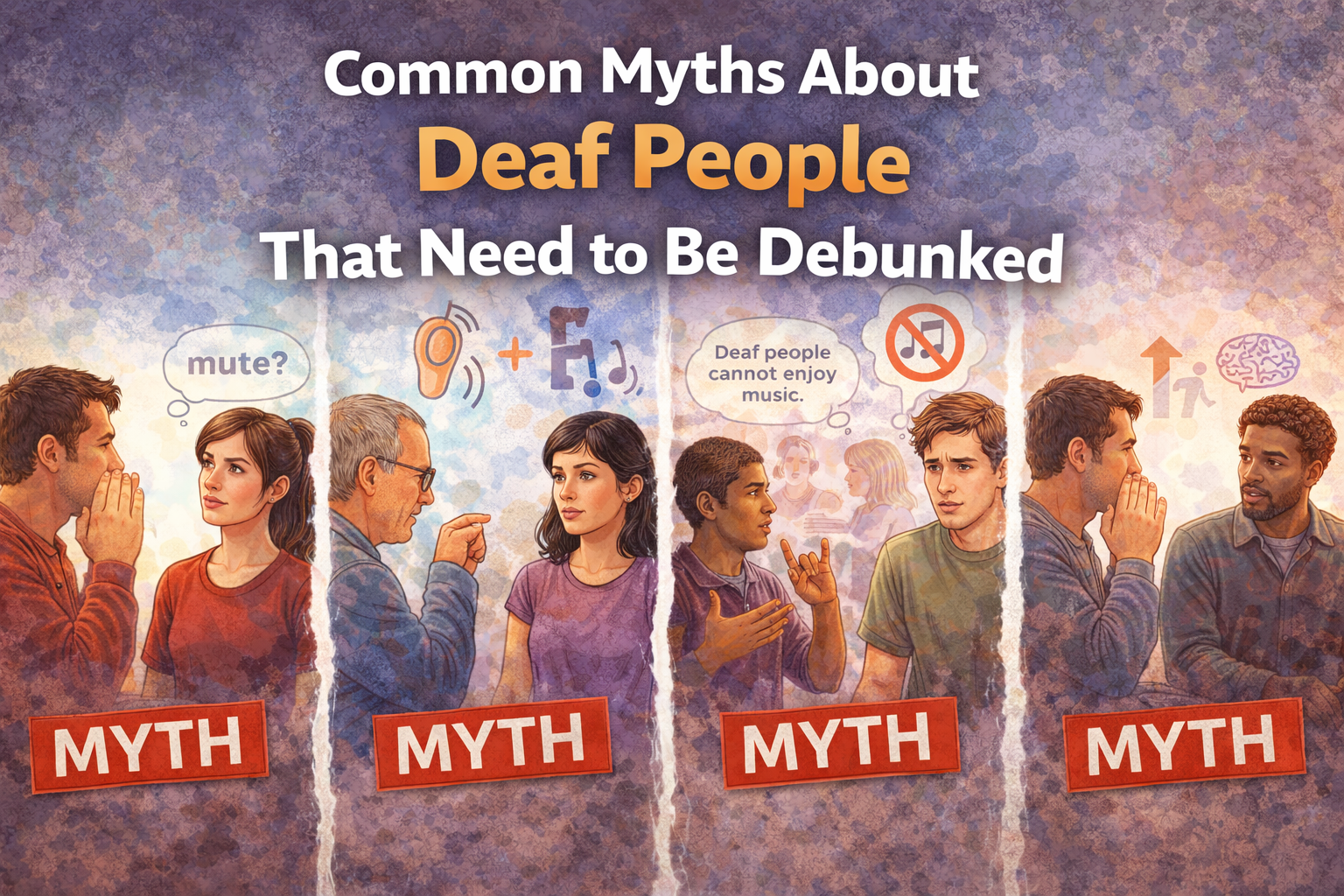
Imagine living in a world where your very identity is constantly misrepresented, where people make assumptions about your intelligence, your abilities, and even your desires, simply because you communicate differently. This is the daily reality for millions of deaf and non-verbal individuals. For too long, misinformation has built invisible walls of prejudice and exclusion.
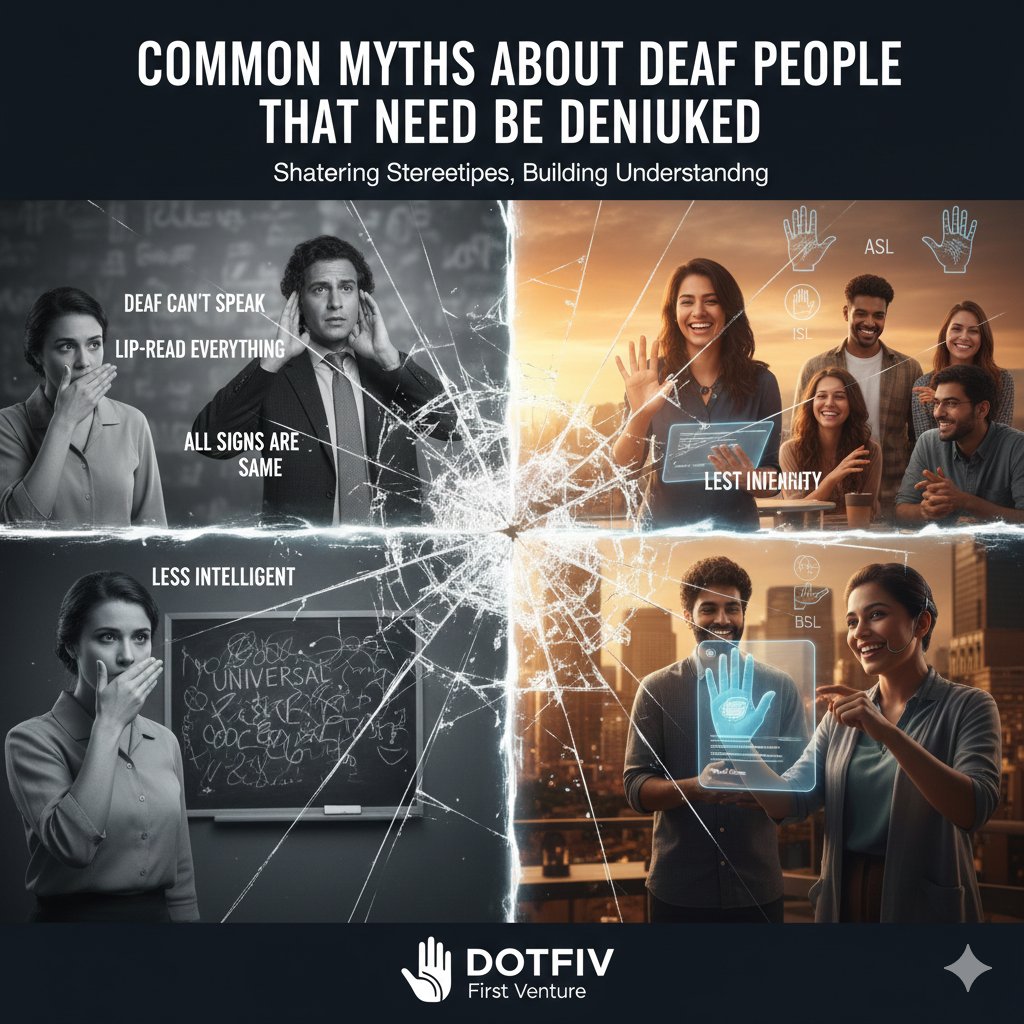
In 2026, it’s time to actively debunk these common myths and replace ignorance with empathy, stereotype with truth. This comprehensive 2,800-word guide will arm you with the knowledge to challenge misconceptions and become a true ally.
Myth 1: “All Deaf People Can Read Lips Perfectly.”
This is perhaps one of the most persistent and damaging myths.
- The Reality Check: Lip-reading (or speechreading) is incredibly difficult. On average, only about 30-40% of English speech is visible on the lips. Many sounds look identical (e.g., “pat,” “bat,” “mat”). Context and guesswork fill in the rest.
- The Effort: Imagine trying to understand a conversation by only seeing a third of the words. It’s mentally exhausting and prone to misinterpretation, leading to fatigue and anxiety.
- The Danger: Assuming perfect lip-reading can lead to crucial misunderstandings in medical, legal, or educational settings, with serious consequences.
Myth 2: “Deaf People Are ‘Mute’ or Cannot Speak.”
This is an outdated and offensive term (“deaf-mute”) that incorrectly suggests a vocal inability.
- The Physiological Truth: The vast majority of deaf individuals have fully functional vocal cords. Their “silence” is usually not due to an inability to produce sound, but because they cannot hear their own voice to modulate pitch, tone, and volume.
- The Linguistic Choice: Many deaf people choose not to speak because sign language is their natural, fluent, and preferred language. Why struggle with an imperfect communication method when a rich, visual language provides full expression?
- The Empowerment: The term “non-verbal” is more accurate for individuals who do not use spoken language, whether due to deafness, autism, or other conditions. It focuses on their communication method, not a perceived “defect.”
Myth 3: “Sign Language is Universal.”
This myth often stems from a lack of understanding of what sign languages truly are.
- The Linguistic Reality: Just like spoken languages, sign languages are distinct, natural languages that evolved independently within deaf communities around the world. Indian Sign Language (ISL) is different from American Sign Language (ASL), which is different from British Sign Language (BSL), French Sign Language (LSF), and so on.
- Grammar & Syntax: Each sign language has its own unique grammar, syntax, and vocabulary. Learning one does not mean you can understand all others.
- International Sign: There is an “International Sign” (IS) system, but it’s more of a pidgin, used for communication between signers from different countries, not a fully developed language.
Myth 4: “Cochlear Implants ‘Cure’ Deafness and Make Deaf People Hear Normally.”
Cochlear implants are powerful tools, but their function and impact are often misunderstood.
- The Technology: A cochlear implant is a complex electronic device that surgically bypasses damaged parts of the inner ear and directly stimulates the auditory nerve. It’s a hearing aid, not a “cure.”
- The Experience: It does not restore “normal” hearing. The sounds perceived are often described as electronic or mechanical, requiring significant auditory training and rehabilitation to interpret.
- The Choice: Deciding to get a cochlear implant is a highly personal choice. Many deaf individuals, especially those deeply rooted in Deaf culture, choose not to get one, valuing their Deaf identity and sign language. This choice must be respected.
- Not for Everyone: Cochlear implants are not suitable for all types of hearing loss or for all individuals.
Myth 5: “Deaf People Are Less Intelligent.”
This is a deeply offensive and entirely false stereotype.
- Cognitive Abilities: Deaf individuals possess the full spectrum of intelligence found in the hearing population. There is absolutely no correlation between hearing ability and cognitive capacity.
- Language Acquisition: Any apparent “delays” in academic performance are almost always linked to language deprivation during critical early development, not to inherent intelligence. If a child doesn’t have a robust language (sign or spoken) to learn through, their academic progress will naturally be hindered.
- Visual-Spatial Skills: Many deaf individuals demonstrate enhanced visual-spatial skills due to their reliance on visual communication and processing of their environment. This often translates into strengths in fields like art, design, and engineering.
Myth 6: “All Deaf People Want to Be ‘Fixed’ or Hear.”
This myth imposes a hearing-centric view on a vibrant cultural group.
- Deaf Culture: Many deaf individuals identify as part of a linguistic and cultural minority (Deaf with a capital ‘D’), not as individuals with a medical deficit that needs to be “fixed.” They value their sign language, their community, and their unique experiences.
- Identity: For those who are culturally Deaf, deafness is an integral part of their identity. Pitying them or assuming they wish to be hearing can be deeply insulting.
- Autonomy: Respecting their choice means acknowledging their right to self-determination regarding their body and identity.
Myth 7: “If You Shout, a Deaf Person Will Understand You Better.”
This is a common, well-intentioned but counterproductive reaction.
- Distortion: Shouting distorts your facial expressions and lip movements, making lip-reading even harder. It also sounds aggressive and can be physically uncomfortable for those with residual hearing or hearing aids.
- No Benefit: For profoundly deaf individuals, shouting makes no difference at all, as they cannot perceive the increased volume.
- The Solution: Speak clearly, at a normal pace and volume, facing the person directly. Use gestures, write notes, or use a translation app if needed.
Myth 8: “Deaf People Can’t Drive, Work, or Live Independently.”
This myth reflects a profound misunderstanding of deaf capabilities.
- Driving: Deaf individuals can legally and safely drive in almost all parts of the world. They rely on visual cues, mirrors, and peripheral vision, often demonstrating excellent awareness.
- Work: Deaf people are employed in virtually every profession, from technology and medicine to art and construction. Workplace accommodations (e.g., interpreters, visual alerts) ensure equal opportunity.
- Independence: With accessible communication and technology, deaf and non-verbal individuals lead rich, full, and independent lives, managing households, raising families, and contributing to society.
Myth 9: “All Non-Verbal People Are Intellectually Disabled.”
This is a grave and dehumanizing assumption.
- Diversity of Causes: Non-verbalism stems from a wide range of conditions (e.g., autism, aphasia, apraxia, selective mutism, deafness), none of which inherently dictate intellectual capacity.
- Hidden Intelligence: Many non-verbal individuals possess high intelligence, deep thoughts, and complex emotions, which they express through alternative communication methods like AAC devices, writing, art, or unique gestural systems.
- The Risk of Assumption: Assuming intellectual disability based on communication method leads to missed opportunities, poor education, and a denial of dignity.
Myth 10: “Deaf People Are Always Sad or Angry About Their Deafness.”
While facing barriers can be frustrating, the idea that deaf people are constantly unhappy about their deafness is a projection.
- Emotional Range: Deaf individuals experience the full spectrum of human emotions. Many are perfectly content, proud of their identity, and joyful within their community.
- Frustration with Barriers: Any anger or sadness often stems from the external barriers and systemic discrimination they face, not from their deafness itself. It’s the “Dinner Table Syndrome,” the inaccessible doctor’s visit, or the prejudiced employer that causes distress.
- Deaf Joy: There is immense joy in Deaf culture—in the visual beauty of sign language, the camaraderie of the community, and the unique ways of experiencing the world.
Conclusion: Building Bridges, Not Walls of Misconception
The power of these myths lies in their ability to create invisible walls, separating us from true understanding. In 2026, as we strive for a more inclusive and connected world, it is our collective responsibility to actively challenge and dismantle these stereotypes.
By educating ourselves, choosing respectful language, and opening our minds to diverse forms of communication and identity, we can replace misunderstanding with empathy, breaking down those walls to build genuine bridges of human connection. Let’s make sure that no one’s identity is defined by someone else’s outdated assumptions.